
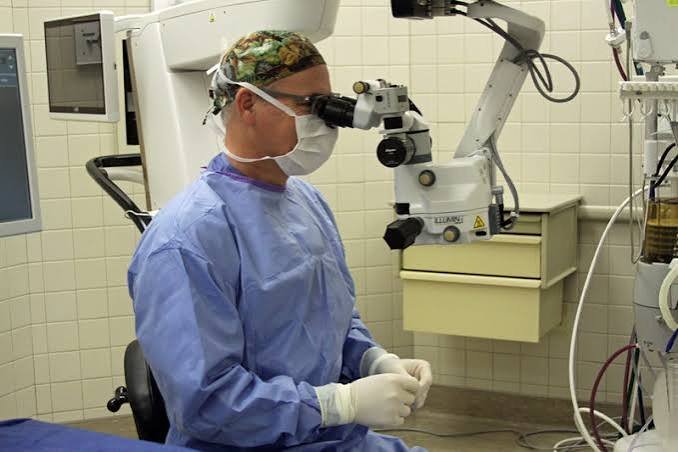
Minimally invasive glaucoma surgery, known as MIGS, is a group of procedures that lowers intraocular pressure. Eye surgeons use MIGS to improve fluid drainage, and the procedures use smaller incisions with less tissue disruption than traditional glaucoma surgery. MIGS is used for selected glaucoma patients; treatment plans include diagnostic testing when specialists determine which approach fits the type and stage of the condition.
What Eye Surgeons Do
Eye surgeons who specialize in glaucoma perform detailed evaluations before selecting a MIGS procedure. Specialists use diagnostic testing to assess the condition, and they tailor treatment to each patient’s type and stage of glaucoma. MIGS is frequently used for mild to moderate glaucoma when better pressure control or reduced dependence on prescription eye drops is needed, and traditional glaucoma surgery remains available when additional pressure reduction is needed.
MIGS lowers intraocular pressure through several approaches. Some procedures improve fluid drainage, while others support the drainage canal, remove diseased drainage tissue, or reduce fluid production inside the eye. These procedures use smaller incisions and less tissue disruption than traditional glaucoma surgery; many procedures can be combined with cataract surgery when the treatment plan calls for both procedures.
The available MIGS procedures use different techniques. iStent Inject W and Hydrus Microstent support fluid drainage, while Kahook Dual Blade goniotomy removes diseased drainage tissue. OMNI canaloplasty and trabeculotomy improve fluid outflow; endocyclophotocoagulation reduces fluid production inside the eye when a procedure targeting fluid production is selected.
Review Treatment Options
Glaucoma treatment extends beyond MIGS. A glaucoma specialty practice provides advanced diagnostics and medical therapy, and its surgical services include MIGS, laser surgery, sustained drug delivery, traditional glaucoma surgery, and premium cataract surgery. Traditional procedures include trabeculectomy and glaucoma drainage implant surgery, and specialists use them when additional pressure reduction is needed.
MIGS also fits into treatment plans that address medication use. Some patients undergo MIGS to reduce dependence on glaucoma medications; certain procedures can be performed during cataract surgery. The treatment plan depends on the patient’s condition; specialists select an approach after evaluating the type and stage of glaucoma.
Monitor Eye Pressure
Diagnostic testing helps specialists evaluate and monitor glaucoma. Optical coherence tomography provides high-resolution imaging, while visual field analysis, gonioscopy, anterior segment OCT, and corneal pachymetry provide additional information about the eyes. Home monitoring also adds information; iCare HOME tonometry allows patients to track eye pressure fluctuations throughout the day while specialists use those readings as part of ongoing monitoring.
Specialists use these findings when planning glaucoma treatment. Home pressure readings can identify fluctuations that do not appear during office visits; collected data can add information to the clinical evaluation when specialists review the patient’s pressure patterns. Detailed testing supports personalized treatment plans because specialists use the results to determine which approach fits the patient’s condition.
Schedule an Eye Evaluation
MIGS provides a less invasive surgical approach to lowering intraocular pressure. Eye surgeons use different procedures to improve drainage or reduce fluid production; specialists select treatment based on the patient’s glaucoma and diagnostic findings. An eye evaluation allows specialists to review the condition; diagnostic findings guide the treatment plan when specialists determine which available option fits.